Wednesday, February 14, 2007

White House opens doors to Iraq refugees


By ANNE GEARAN, AP Diplomatic Writer


The Bush administration plans to allow about 7,000 Iraqi refugees to settle in the United States over the next year, a huge expansion at a time of mounting international pressure to help millions who have fled their homes in the nearly four-year-old war.


The United States has allowed only 463 Iraq refugees into the country since the war began in March 2003, even though some 3.8 million have been uprooted. A senior State Department official described the expanded program on condition of anonymity ahead of a formal announcement later Wednesday.


The administration also plans to pledge $18 million for a worldwide resettlement and relief program. The United Nations has asked for $60 million from nations around the world.


Secretary of State Condoleezza Rice met Wednesday with U.N. High Commissioner for Refugees Antonio Guterres to outline the expanded U.S. program. The 7,000 would be resettled from nations outside Iraq where they have fled. The U.S. proposal also includes plans to offer special treatment for Iraqis still in the country whose cooperation with the U.S. government puts them at risk from sectarian reprisal.


Most refugees have fled to Syria and Jordan, both of which have recently tried to restrict the influx. The U.N. estimates that 40,000 to 50,000 people flee Iraq each month and have dwindling options of where to go. Other Iraqis relocate inside then country, with some leaving neighborhoods that were once mixed among Sunnis and Shiites and resettling where their sect is more concentrated.


U.S. diplomats have discussed the refugee situation directly with the Syrian government, the State Department official said. That is notable because of the administration's reluctance to engage Syria in high-level discussions about security in Iraq. The U.S. has also discussed the refugee problem with Jordan, a close ally, the official said.


The U.N. and allies have suggested the previous U.S. policy was stingy considering the U.S. role in starting the war. After The Associated Press reported the plan to allow far greater numbers to come to the United States, Jordan's chief government spokesman did not sound impressed.


Nasser Judeh said 7,000 is still a small number compared to the 700,000 Iraqi refugees Jordan has had to accommodate.


"7,000 Iraqi refugees is just 1 percent of the number we have," Judeh said.


Syria has taken in an estimated 1 million Iraqis. It was the last Arab country to take in large numbers.


The U.N. classifies most Iraqi refugees as having only "temporary protection status," rather than as permanent refugees — presumably because it assumes most will return to Iraq after the fighting ends. Guterres' office has said it hopes to permanently resettle this year up to 20,000 Iraqis whom it considers the most vulnerable, including women, children, survivors of torture, the seriously ill and minorities.


The worsening humanitarian crisis has resulted in calls for action by members of Congress and a plea from the United Nations for more countries to help out.


"It's not fair that the burden is not being shared effectively. A very limited number of countries is paying a very heavy price," Guterres said on a recent tour of the Mideast.


In a budget request filed with Congress last week, President Bush asked for $35 million to help Iraq's refugees next year, and another $15 million for this year.


Sen. Patrick Leahy, D-Vt., said the administration "has been slow to react to a worsening situation, amid ample warnings." Sen. Richard Lugar, R-Ind., told Rice at a hearing last week that the United States could admit about 7,000 Iraqi refugees this year.

Tuesday, February 13, 2007

Nigerian Kidnappers release 24 Filipino hostages


By Estelle Shirbon


Nigerian kidnappers have released all 24 Filipino seamen they had been holding captive in the creeks of the oil-producing Niger Delta since January 20, the men's employer, German shipping firm Baco-Liner, said on Tuesday.


The kidnappers said they had freed the men "on humanitarian grounds" without receiving any ransom, following the intervention of local elders and authorities. Most abductions in the anarchic Niger Delta are resolved after money changes hands.


"All 24 hostages are on board our vessel, Baco-Liner 2, and they're on their way to Warri now where they will be handed over directly to our agent," a spokesman for the company said, referring to the main city in the western delta.


He said the men were tired but in good health.


Another seven foreign hostages seized by different armed groups are still in captivity in the delta, where violence against expatriates and against the oil industry is on the rise. The remaining hostages are two Italians, one Lebanese, one American, two Filipinos and one Frenchman.


The kidnappers of the 24 Filipinos said they had seized the Baco-Liner 2 because it was "suspected to have been conveying arms and ammunition imported by top politicians in the country, to destabilize the 2007 general elections in the region."


Nigeria is due to hold elections in April that should mark the first democratic transition from one civilian government to the next in Africa's top oil producer.


The Baco-Liner spokesman said there were explosives on board the cargo ship but these were destined for oil companies that use them for exploration and had nothing to do with politics.


"We are not engaged in any smuggling whatsoever," said the spokesman.


DIVISIONS AMONG REBELS


The kidnappers said they would take unspecified "further actions" unless Nigerian authorities met a series of demands including the release of two jailed leaders from the delta and the payment of compensation to local villages for oil spills.


The abduction of the 24 Filipinos exposed divisions among rebel groups in the delta.


The kidnappers said they were from the Movement for the Emancipation of the Niger Delta (MEND), whose attacks a year ago forced the closure of 500,000 barrels per day in oil output, a fifth of Nigeria's capacity. That production has not resumed.


But Jomo Gbomo, who has always spoken for MEND since the group emerged in late 2005, has repeatedly denied his group was involved in the abduction. He says a separate group was responsible and MEND does not share that group's objectives.


Activist sources in the region say the group who kidnapped the Filipinos used to have links with Gbomo's MEND about a year ago, but they had fallen out. MEND has sometimes worked with pre-existing militias whose agendas are based on local issues.


Poverty, lawlessness and a collapse in public services due to rampant corruption among government officials lie at the root of the problems in the Niger Delta, where the lines are blurred between political militancy and crime.


Most residents of the vast wetlands region live without clean water, electricity, roads or functional clinics and this fuels resentment toward the multibillion-dollar oil industry.


Attacks on oil facilities, kidnappings for ransom, smuggling of stolen oil, armed robberies and assaults on the security forces are all common. Many fear the situation will worsen ahead of April's elections as armed thugs hired by politicians to intimidate their opponents spring into action.

Monday, February 12, 2007

Edwards to retain embattled bloggers


By NEDRA PICKLER, Associated Press Writer


Democratic presidential candidate John Edwards said Thursday he was personally offended by the provocative messages two of his campaign bloggers wrote criticizing the Catholic church, but he's not going to fire them.


Edwards issued a statement and answered questions about the fate of Amanda Marcotte and Melissa McEwan, two days after the head of the conservative Catholic League for Religious and Civil Rights demanded they be fired for messages they wrote before working on the campaign.


"I talked personally to the two women who were involved. They gave me their word they, under no circumstances, intended to denigrate any church or anybody's religion and offered their apologies for anything that indicated otherwise. I took them at their word," Edwards told reporters during a campaign stop in Charleston, S.C.


An angry Bill Donohue, president of the Catholic League that counts 350,000 members, criticized Edwards for not firing the two bloggers. Donohue also promised a nationwide public relations campaign in newspapers, magazines and Catholic publications to tell voters what the candidate had done.


"When Mel Gibson got drunk and made anti-Semitic remarks, he paid a price for doing so. When Michael Richards got angry and made racist remarks, he paid a price for doing so. ... But John Edwards thinks the same rules don't apply to him, which is why he has chosen to embrace foul-mouthed, anti-Catholic bigots on his payroll," Donohue said.


Edwards has never met the two bloggers and his first conversation with them came when he called to discuss the uproar. The 2004 vice presidential nominee told reporters in South Carolina: "It will not happen again. That you can be sure of."


The campaign distributed written regrets from the two women, who stressed they were writing on personal blogs. Edwards said in the statement he believes in giving everyone a "fair shake."


On Tuesday, Donohue called for Edwards to fire the bloggers, citing posts that the women made in the past several months in which they criticized the church's opposition to homosexuality, abortion and contraception, sometimes using profanity.


"The tone and the sentiment of some of Amanda Marcotte's and Melissa McEwan's posts personally offended me," Edwards said in the statement. "Everyone is entitled to their opinion, but that kind of intolerant language will not be permitted from anyone on my campaign, whether it's intended as satire, humor or anything else."


The two were hired last week as part of Edwards' outreach to liberal voters and online activists.


Edwards spokeswoman Jennifer Palmieri said the campaign was aware that Marcotte and McEwan, like many bloggers, had written provocative postings on their personal sites. But the campaign had not read them all and had not seen the postings criticizing the church until Donohue put out a statement Tuesday, Palmieri said.


For instance, Marcotte had written that the church wants "to force women to bear more tithing Catholics" and McEwan had written that the pope is among those who "regularly speak out against gay tolerance." Other postings used more graphic language.


Edwards remained silent for two days as the controversy grew on the Internet. Most of those posting on liberal Web sites were calling for Edwards to keep the bloggers on staff and stand up to Donohue, and many were vowing to work against him if he didn't.


Donohue is a frequent critic of those who speak out against the church and what he calls "political correctness run amok," such as the separation of Christmas and the holiday season.


Donohue also doesn't shy from blunt language sometimes in his criticism of gays, Hollywood's control by "secular Jews who hate Christianity" and even the Edwards bloggers, whom he referred to as "brats" in an interview Wednesday on MSNBC.


Palmieri said Edwards had been traveling through Michigan, Missouri and Oklahoma and wanted time to discuss the bloggers' statements with them and weigh their future.


"We're dealing with people's careers and reputations and livelihoods," Palmieri said.


In her statement, McEwan said she doesn't expect Edwards to agree with everything she's posted, but they share "an unwavering support of religious freedom and a deep respect for diverse beliefs.

Marcotte's statement said her writings on religion on her blog, Pandagon, are generally satirical criticisms of public policies and politics.

Catholics in Alliance for the Common Good, a nonprofit formed to highlight Catholic social justice teachings, also issued a statement condemning the bloggers' remarks but accepting Edwards' assurances that he was also offended.

"Catholics comprise more than one quarter of the U.S. public, and neither John Edwards nor any other candidate can afford to take this constituency for granted," said executive director Alexia Kelley, who served briefly as a religious adviser to 2004 Democratic presidential nominee John Kerry.

Saturday, February 10, 2007

U.S. contractor shot by U.S. forces

Associated Press

The U.S. military confirmed on Saturday that American forces at Camp Anaconda, the huge air base north of Baghdad, shot and killed a civilian contract truck driver.

A spokeswoman for KBR, a contracting subsidiary of Halliburton that was formerly known as Kellogg, Brown & Root, said the shooting was under investigation.

Melissa Norcross, the KBR spokeswoman, said the company was not releasing the name of the dead driver or a second person in the truck who was wounded "to protect the individuals' privacy."

In Baghdad, Lt. Cmdr. Bill speaks said, "There was an escalation of force incident at Camp Anaconda on Feb. 5 (Monday) that resulted in the death of a civilian contractor. The incident is under investigation by the Army Criminal Investigation Division and KBR."

An escalation of force incident normally means a driver approaching a checkpoint did not respond to military orders to approach slowly and stop.

"Sadly, 98 KBR employees and subcontractors have lost their lives, and more than 430 have been wounded by hostile action while performing services under the company's government contracts in Iraq, Afghanistan and Kuwait," Norcross said in an e-mail response to queries about the incident.

Halliburton is spinning off KBR into its own separate, publicly traded entity.

Tuesday, January 16, 2007

Challenges facing Africa's entrepreneurs


BBC


Africa is often seen as a high-risk place to do business, but the continent is increasingly becoming a hospitable destination for investors.


At the start of a special series looking at business in Africa, BBC World Service Africa editor Martin Plaut assesses the challenges facing the continent's entrepreneurs.

Africa's wars, coups and famines are constantly in the news - the image of starving children is what often comes to mind every time the continent is mentioned.

But what about the men and women who are starting businesses, and risking their own money to build Africa's economies?


HAVE YOUR SAY
In especially stable countries foreigners are taking advantage. Are they seeing something we Africans are not?
Wesley Ngwenya

Despite all the obstacles, growth rates across much of Africa are rising and there are successful ventures to be found everywhere from Mogadishu to Dakar.

It is one of those seldom told stories - the success now being notched up by men and women doing business across Africa.

The results are not hard to see.

Economic growth has been running at a very respectable 4% in at least 15 African countries for the last decade.

Red tape

In the Democratic Republic of Congo, registering a business takes 155 days, while enforcing a contract in Angola involves 47 procedures and takes over 1,000 days


Of course a good deal of the growth can be put down to rising prices of minerals.

Oil is now benefiting countries all along the West African coast, from Nigeria to Angola.

But there is much more to it than that.

From telecommunications and banking to the export of fruit and flowers, Africa is now finding and cultivating niche markets around the world.

Behind these statistics are stories of initiative and drive to overcome the familiar problems of endemic corruption and mountains of red tape.

Business of politics


The absence of a strong business class at independence for many countries in the 1960s was a major inhibition to growth, argues Teddy Brett, of the London School of Economics.

It meant that fighting to control the levers of politics became a key way of winning economic advantage.

And the results are plain to see.

Doing business in Africa is still hard work, as a recent World Bank study indicated.

It showed that out of the 35 least business-friendly countries in the world, 27 were in sub-Saharan Africa.

Some are impossibly hard. In the Democratic Republic of Congo, registering a business takes 155 days, while enforcing a contract in Angola involves 47 procedures and takes over 1,000 days.

All this means plenty of room for the so called "gate-keepers" - the bureaucrats whose palms must be greased to get things done.

Taking risks

As if that isn't bad enough, roads are bad, electricity unreliable and skilled labour in short supply.

But if you succeed, the profits can be large.

South African mobile phone company MTN took a risk and invested in a country as notoriously difficult as Nigeria, but has made a tidy profit.

And the business climate across the continent is improving.

Fresh funding


Promises made by world leaders at last year's G8 summit in Gleneagles are beginning to come through.

In August, Malawi became the twentieth African country to have its debts cancelled.

And fresh funding is beginning to come through, to meet the promise of doubling aid to Africa by 2010.

This means more money for improving the energy supplies and renovating everything from airports to shipping terminals.

This has provided an environment in which business can begin to grow, and it is a challenge that men and women across the continent are starting to take up.

Guinea Takes Control of "Its" Minerals

By Katrina Manson and James Knight
Sangaredi, Guinea, West Africa


"It is not hot news that most African countries possess resources-natural, human, and otherwise that if properly exploited would place African countries as one of the most richest in the world. But most of the continents resources are being exploited and taken to the western world at cheap rates, where they are processed and who becomes the sole consumer of the more expensive end products? The same people who produced the raw material in the first place. What is wrong with investing in Africa? This trend seems to have no end at hand.
Natives of this rural community in Guinea have every cause to become agog, their hearts filled with great anticipation for the future.
But the questions that pops up in mind is "How far will this go? When the need for increased production arises and computers begin to take over peoples jobs...will there still be anything left for these poor people who are devotedly making big sacrifices for their future and the future of their nation?"
We hope that this does not become another case of the Niger Delta in Nigeria; we hope that the plan in place is both efficient and effective, to ensure that these people are not only given fish but also taught how to fish-that they become trully empowered. We hope that this step taken by Global Alumina, will be followed by many more other foreign investors to help develop Africa.
Let us hope and pray that the future for the Sangaredi community, for Guinea, for Africa and indeed the third world will be as bright and beautiful as the smiles on the faces of these people."


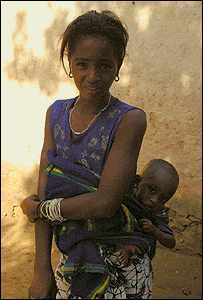
Ansata Bah jiggles the baby wrapped to her back. At 13 years old, she has the weight of her world on her shoulders.


In March, she, along with her child, husband and fellow villagers, have to move out of their settlement in rural Guinea, West Africa.

They are making way for a new $3bn (£1.5bn) factory that in 2009 will start to turn Guinea's vast supplies of bauxite into alumina, the aluminium ore from which aluminium is made.

But what could have been a nightmarish corporate attack on village life may prove a blessing.

The project, based in Sangaredi, is giving hope to poor communities desperate for jobs that have for decades seen their region's mineral wealth exploited abroad.

"If I can get some activity, it doesn't matter what - washing clothes, preparing food - I won't hesitate to do it," says Ms Bah.

"Whether it's during the phase of construction or exploitation, anything that I can do to earn money I'll do.

"If I gain work here, living standards will improve compared with now."

Exploited abroad

Despite possessing at least a third of the world's bauxite reserves, Guinea has failed to convert it into a more precious commodity.

Foreign aluminium companies, such as US-based Alcoa and Canadian firm Alcan, mine the rock in Guinea, but transport it abroad for refining.

It means the country misses out on a crucial economic boost: whereas a tonne of bauxite costs about $20 on the world market, spot prices for refined alumina can reach $400 a tonne.

Global Alumina, the Canadian-listed company behind the new plan, hopes to produce 2.8m tonnes of alumina per year from the new plant when it opens in 2009.

Often critical of the motives and priorities of big business in Africa, development organisations are behind the project.

"Nothing of this scale has been done in Guinea before," says Lamine Bangura at Centre d'Appui au Developpement (CAD), a local non-governmental organisation supported by the US-backed African Development Foundation, which has entered into a $10m partnership with Global Alumina to oversee training, construction and sustainability issues related to the refinery in the area.

"It will create a great deal of employment.

"The installation of the factory will bring great development for this community."

Social developments

"Global is a detonator," says Noramou Cece, technical advisor at the Ministry of Mines.

"The company has consulted at the base, family by family, individual by individual, to reassure the population that Global Alumina will listen to them.

"As a result, there is a new spirit taken on by the mining companies that come here - that they must be involved in the development of community at the grassroots level."

A four-year social and environmental impact assessment, one of the most far-reaching of its kind, sought out the opinions of each of the 4,000 locals affected by the refinery.

Ansata Bah is one of the beneficiaries of a $10m compensation package that will see two new villages built, complete with new sanitation, schools and dispensaries, compensation for lost trees and parcel lands, alongside increasing roles for women and the much-hoped-for prospect of jobs.

Ms Bah personally received compensation for her own mango and lemon trees and the palm oil that she makes with the other women.

The women in her village know how much she has received, but she says the men, including her husband, are not allowed to know the amount.

Social change

Bringing an in-depth consultation process to traditional village communities has had far-reaching effects.

Many women have found a voice and independence for the first time.

"Women here are starting to have free thoughts as a result of our discussions," says Marliatou Diallo, women and vulnerable persons officer at Global Alumina.

"Before, women could not even express themselves in front of men, and definitely not take a decision.

"Now they can explain their problems to the men and give their opinions and concerns."

The United Nations Development Programme (UNDP) has partnered with Global Alumina to try to meet the Millennium Development Goals on halving extreme poverty by 2015.

Together Global Alumina and the UNDP will commit hundreds of thousands of dollars for projects including vocational training, developing small businesses and financing micro enterprises.

Global Alumina will also fund mid-wife training and poverty-alleviation programmes.

Job hopes

As Guinea's largest foreign direct investment yet, the whole country is waiting for jobs at the factory with bated breath.

Guinea suffers from chronic unemployment, particularly among young people, and even those with secondary and tertiary qualifications struggle to find jobs.

The economy is in freefall, with spiralling inflation, and the dire economic prospects sparked strikes and protests in 2006.

"We're going to take 3-4,000 workers from this area alone during construction, so that will have a big impact for the inhabitants of this region," says Mamady Youla, Director General of Guinea Alumina Corporation, Global Alumina's subsidiary in Guinea.

"Once the factory starts we will employ around 2,000 people directly, but you must also take into account the indirect employment generated by the project - we expect about 10,000 jobs to be generated in the region."

The Guinean government has realised the importance of the project, and created incentives, including a fifteen-year tax holiday, with no taxes on profits for the first five years, to sweeten the deal.

As a result, other companies, including Alcoa/Alcan, Mitsubishi, Chalco and Brazilian firm CVRD, are looking at the possibility of establishing alumina refineries in the country.

In the long-term, Youla estimates that revenues in the order of $100m could accrue to government every year.

He is pushing for a greater percentage of these taxes to go to the local community. Currently only 0.4% of revenues has to go to the local area, but he would like to see this increased to 5% or 10%.

Better living standards

Souleymane Bah, 70, a village elder from Petoun Djiga, one of the two villages that will be relocated, cannot wait for the project to gather pace.

He received a cheque compensating him and his family for 50 trees.

"We are only farmers, so it's thanks to Global that I ever touched a cheque. We are very content for them to be here," he says.

"I want the project to develop as quickly as possible, he says.

"We ourselves think of development, and that's why we accepted to be relocated.

"If young people can find employment around the project here, then we think living standards will improve."

Oil Gunmen kill Nigerian Chiefs


BBC NEWS

Gunmen in Nigeria's oil region have attacked and killed 12 people including four local chiefs, police say.

When The Foreign Expatriates are gone they turn to the "Local Expatriates", like crocodiles who eat their own eggs. "The popular quote in economics is thus justified: when the desireable is unavailable, the available becomes the desireable".

Two passengers who suffered gunshot wounds during the attack escaped from a boat that was carrying 14 passengers to Kula village in the Niger Delta.

The four chiefs were from the Kula kingdom in Rivers State.

Western oil companies have also evacuated their staff from three oil fields in the area, where kidnappings by armed groups are quite common.


Sources in the Kula community say the attack was prompted by disagreements between local groups over sharing out money distributed by oil companies operating there.

There are also reports that the attack could have been a result of a long-standing chieftaincy tussle.


The chiefs who were killed on Sunday had been in control in Kula over the past two years.

The faction that launched the boat attack are said to have been driven out of Kula two years ago after they challenged the authority of local chiefs to share oil money.

Although all of Nigeria's oil exports come from the Niger Delta, the region remains poor with local groups taking up arms to demand larger control of the oil wealth.

The government says instability in the Delta cost some $4.4bn last year.