I watched the news to see a few Nigerians blindly chanting that the removal of subsidy is for the benefit of Nigerians, all because they wanted to reopen their shops. I laughed. This goes a long way to show our gross disunity. If Egypt and Tunisia got tired of their protests and revolution, would they boast now of having a platform that allows them to choose the government they want?
I am not against the policy as you may have judged from my article, but I strongly hold that there are better ways of implementing it, to make it work in Nigeria. There are however, solid facts that I want you to consider and then judge for yourself if this government can deliver its promises.
I supported President Jonathan – even though my location did not allow me vote – for sentimental reasons and so did the majority of Nigerians; but I still do support him. I was also of the opinion that after former President Obasanjo, Nigeria shouldn’t have another president that was a past military president. But during his campaign I was not comfortable with the amount of money President Jonathan expended, paying artistes, organizing rallies and mobile carnivals. This money was obviously sourced from public funds. As painful as this may sound, President Jonathan has weak links that portray him as corrupt. For instance, members of the houses of assembly resisted vehemently when the CBN governor, Sanusi Lamido Sanusi presented facts that showed that the cost of running this government was guzzling about 25% of the country’s budget. Nigerians are well aware of the unwarranted multimillions that the presidency, senators, legislators and ministries accrue to themselves as salaries and allowances and how they unjustly devalue the official vehicles assigned to them only to repurchase them at alarming diminished prices. It’s open news now that the president allocates One billion Naira to himself as feeding allowance annually. My calculation shows that if you spend N30, 000.00 per day, it would take you 80 years to expend ALMOST a billion naira; the figure is N876,000,000.00 or N876,600,000.00, considering the leap years. You can do the calculations yourself to confirm.
Within its practical two years of inception, I did not expect this government to transform agriculture or power; these are monumental achievements that take time. However one task that was very feasible was to fight corruption to the letter. If this singular act was achieved, a vote of trust would have been bestowed on this government.
Consider these realities:
PHCN makes profit annually from bills being paid; where does this money go to?
The Water Board also makes money from its services; where is this money being lodged?
Governor Fashola of Lagos has provided satisfactory evidence that government can generate income from tax. The FIRS generates income yearly from taxes; where is this money?
What about the money the Customs make from import duties?
How about the Immigration, FRSC and other government institutions that generate money in various capacities?
Currently as we speak, some elite Nigerians have licences to mine solid minerals in diverse parts of the country; these minerals, like crude, should be the sole property of the federal government.
Nigeria recovered monies from misappropriated funds, to the tone of $380M from the Obasanjo tenure till now; where is the evidence of that money now? These go to show that the government has abundant alternative sources of income without having to touch the subsidy money.
Can this government conveniently prosecute former President Obasanjo and other government officials who committed gross crimes of corruption in the near and distant past? Governments in Nigeria have a very amusing practice of claiming to forgive leaders with glaring corrupt records as recorded by the EFCC, yet most of these individuals like Senators Ahmed Mohammed Makarfi and Sani Yerima, both former governors of Kaduna and Zamfara States respectively, still served in government offices, and now walk liberally as free men. Several others like Lucky Igbenedion, Ikedi Ohakim, Orji Uzo Kalu, Peter Odili and many others are still walking freely. This is ridiculous! When God directly governed Israel in the past, evildoers were punished for their crimes. Even though we know God to be merciful, He is also a just God. The United States of America is known to investigate crimes as old as thirty years and over, and prosecute as well as punish the offenders accordingly. Several other countries have this same appropriate practice of adequately punishing criminals. Nigeria callously sweeps these crimes under the carpet and what’s the result – more daredevil criminals emerge, crime prevails and the countries’ economy suffers.
Nigerians are not opposed to the removal of subsidy, but in the manner of its implementation. This government and previous ones before it have always shown grave disregard for the Nigerian people. It was clear that the subsidy removal was still being deliberated on and then a day after the president declares a state of emergency in fifteen Local Government Areas in four states of the federation, an indication that the nation was in a delicate situation, we get the shocking news of the subsidy removal. Many Nigerians still remain stranded in their villages due the consequent transportation price hike; given the economic severity of the month of January in Nigeria, the government only succeeded in replacing one crises – the Boko Haram menace, with another. And while previous governments have failed in their promises, this government has acted very similarly; so how does it expect any trust from Nigerians? If an individual was served a meal of a particular kind of vegetable from two distinct sources at two separate times, and on both occasions this individual ends up severely sick, do you think such a person will ever eat any other kind of green vegetable? Answer is NO. A person like that will in fact, naturally become repulsive to anything green. We have a proverb that a snake will naturally beget something long. The plans for the subsidy money are very juicy and welcome, and in fact portray the expectancy of Nigerians from any government. But the fact that this government possesses traits of failed previous dispensations as well as corrupt members opposed to development who served in previous dispensations, it stands on a knife-edge that makes its plans prone to failure. The NLC and its associates and the Nigerian people are therefore within their rights to demand that the government reverts to N65.00 per litre – the point of deliberations – before they engage in dialogue.
This government did not just discover the corrupt cabals and their activities overnight; it has been aware of them for a considerable period of time. It should therefore have confronted them all along.
Arguments are made that neighbouring Ghana also implemented removal of subsidy without complaints and so questions why Nigerians should. Study the mode of implementation in Ghana. Ghana DID NOT remove subsidy in one blow. The Ghanaian government has been removing its subsidy in installments of 20% over a period of time, using these monies to develop aspects of the economy at a gradual pace. What was removed on 29th December, 2011 was the last installment. So you see that an excellent and very humane approach was employed. The Igbos have a proverb: You first of all chase away the leopard before you begin to remonstrate with the wayward hen for venturing so far into the forest. Another proverb says: You do not get rid of the baby along with the bathe water. In both cases the proverbs indicate that you have an asset in a threatening situation, but you don’t punish your asset in a bid to deal with the threat. In the light of the present crisis, it means that the government cannot punish its asset – the masses, to deal with the crisis – corruption (or the oil cabals).
The Nigerian government should have employed this very same method, while in the process, tackling the activities of the cabals radically; like revoking their importation licence, and rightfully charging them to court on charges of short-changing and exploiting the government as well as other relative crimes. The government can then proceed to engage new interested importers on very strict contract agreements, for instance, a condition that guarantees their balance payments only when the accurate volume of fuel has been ascertained to enter government storage. The government could even create its own importation outfit. Whichever method is employed should be made transparent by involvement of non-governmental institutions like the NLC, TUC, Civil Society, etc, who will help monitor the distribution of these products down to the public. While this is going on, a severe war on corruption should be engaged on corrupt practices in all sectors. If five to ten prominent individuals are investigated, prosecuted and incarcerated within a short period, intending and existing individuals with corrupt intentions would take caution and be kept at bay.
While taking away the subsidy may seem a plausible way of confronting the cabals, I see a gaping loophole. As long as they remain free, these cabals will embark on methods to hijack oil products from within. The subsidy project would therefore have been defeated. The best way to proceed is as described above, similar to what the NLC, TUC and Civil Society are suggesting.
On a final note, I appeal to the government to stop wasting valuable money on television jingles and billboard adverts encouraging Nigerians to be peaceful and law-abiding. While this practice is the norm in Nigeria, I say that it is non-effective. Peace is not something you can cajole a person or people into. Peace is a product; it is the product of Justice. When there is justice, peace follows naturally. The human psyche if unrefined is prone to crime. But when people know that regardless of their status social or otherwise, their crimes under a just society are adequately punished by an unbiased law, the mind starts to work in the opposite – more productive – dimension; which happens to be Peace. We make a lot of reference to America. America did not coax its citizens into accepting peace. She simply enforced a law that works and people began to trust the law and to engage in peaceful living.
Showing posts with label Africa. Show all posts
Showing posts with label Africa. Show all posts
Saturday, January 14, 2012

Thursday, January 5, 2012
NIGERIA - ON THE REMOVAL OF FUEL SUBSIDY
While the Federal Government has made good its decision to withdraw the fuel subsidy, it would be in the best interest of the entire Nigerian populace that the government revisits its decision and make adequate readjustments before the country erupts in utter chaos. Whatever discussions and talks the NLC would be holding with the government, it is paramount to note that taking away one hundred percent of the subsidy is a completely wrong move.
I have listened to several arguments opposing and supporting the removal of the fuel subsidy. It is unfortunate that initially, most people seemed to only see the austere effects of the removal, on the aspect of transportation alone. Nigeria’s dependence on crude oil has led us to a situation that causes us to experience consequential effects whenever there is a change in the prices of petroleum products, particularly Premium Motor Spirit – PMS. By implication, with the removal of the subsidy, every commodity and I repeat, every commodity in every sector would also experience an increase in prices. I’m talking about monumental increases in the costs of living/housing, food, education, health, etc.
The Federal Government claims that it plans to use the money from fuel subsidy for the purpose of industrialization, the absence of which has be cited severally as the bane of Nigeria’s gross unemployment. This decision I am sure would be welcomed by every well-meaning Nigerian. But there is great need for skepticism.
Firstly, what concrete evidence do we have that this money would be used for the purpose for which it was meant? Nigeria has had a nasty history of taking loans from foreign sources, monies that never served the purposes for which they were meant, but ended up in the pockets and accounts of a very greedy few; what will this insensitive individuals not do to siphon this new fund which happens to be OUR OWN money and immune to international scrutiny? Bear in mind that there are Nigerians whose wealth thrive from the dilapidated state that is presently characteristic of Nigeria’s economy; these individuals would do anything and I mean absolutely anything to keep Nigeria the way she is. Hence these people are sure to thwart or sabotage whatever developmental plans the government has or plans to implement. What concrete measures have been put in place to ensure that while the government carries out her developmental schemes, there are also active machineries to investigate and prosecute any singular move or ambition to sabotage government plans? Absolutely Nothing! The EFCC and ICPC have done very little to nothing, partly because Nigerian laws seem to be void over some individuals, while some others deliberately hamper the activities of these anti-graft institutions. We have heard of many highly placed Nigerians involved in acts of corruption; none of them was successfully prosecuted and punished. I could go on and on listing several diverse avenues that the government has failed especially in its bid for nation building, and tackling corruption that hampers it. There is definitely nothing available to serve as guarantee that the fuel subsidy money would serve its purpose. This is not a fairy tale. This is reality and reality goes with facts. WE cannot give this government any benefit of doubt simply because the President’s name is Goodluck (all due respects to Mr. President). We need facts to prove but unfortunately, this government gave none.
As regards facts, you may wonder what example I have. I am of the opinion that rather than withdraw one hundred percent of the subsidy money, the government should have taken at most seventy percent of it and left thirty percent for at least two years to serve as a cushion to insulate the harsh effects that would emanate from the removal. With seventy percent of the subsidy money, the government can start its programmes and whatever positive results are recorded can serve as surety that the government’s plans are genuine and viable.
Also, why does it always have to be the masses bearing the brunt of every austere measure embarked upon by the government? If the Nigerian government needs money I proffer that it can generate so much from cutting by half, the salaries and allowances of political office holders, beginning from the President himself, down to the Councillor. They too should feel the pinch and make sacrifices too. And as the old Nigerian slogan goes: “They shouldn’t worry; they would suffer now and enjoy later.”
In furtherance to this argument, I purport that given the present harsh economic condition of Nigeria it would be absolutely wise that the jobs in both Houses of Parliament, as well as State Houses of Parliament be stripped of their status as permanent appointments. Senators and Legislators should cease to be direct federal government employees. They should be paid just for their sitting allowance and this through their constituencies. Also, these wages should commensurate with the adequate salary grade level of a civil servant. This way, Senators and Legislators would need to have jobs and businesses of their own, where their true income comes from; the parliamentary jobs in Abuja would no longer be their beds of roses. As a result, they would be truly committed to implementing policies since payment of their wages would depend on their performance. If the members of parliament oppose this decision – as likely they would – the president can sponsor the bill for this purpose and call on Nigerians to a referendum in support of the bill and I can guarantee you that all Nigerians would arise in support of the president.
Millions of Nigerian youth sustain themselves and keep out of trouble by engaging in menial and low-paying jobs run by private entrepreneurs. These make up a good percentage of the unemployed youth that over the years, every government has incessantly proclaimed its plans to keep engaged in order to restrain them from crime. The majority of these jobs pay monthly wages within the range of five and eight thousand naira, and this provides the stipends on which the youths finance their basic needs. With this increase, the bulk of their salaries – about seventy percent – would be spent on transportation alone; some may spend virtually their entire earnings on transport. I don’t see anybody keeping a job like that anymore. Then in time, this development would result in an increase of street thugs and hooligans.
The government of President Goodluck Jonathan should be advised to see things and reason in this light and subsequently revisit and readjust the subsidy removal. There is so much at stake especially the stability of Nigeria. Nigerians have been known to gullibly adapt to harsh conditions. But I do not see how anybody would adapt to a condition that takes away your entire salary on transport alone, with very little to feed on, when you still have housing, health bills, utility bills, costs of dependents, etc, to contend with.
PS: As an afterthought, I wonder if the advisers of President Goodluck Jonathan may have been compromised by diabolical oppositions to his government, for them to have proffered a suggestion like this. What is it now with this importation of diesel engine buses? First, inadequacy of funds was cited as one of the reasons for subsidy removal. Then they come and say in response to the protests they want to import buses. Where is the money for the procurement of these buses coming from? This venture will create an avenue for one individual or group of individuals to squander valuable funds in purchasing sub-standard vehicles that will become crises within three months of usage. How many buses does the government intend to buy to satisfy the needs of the entire Nigerian people? Is this government bent on getting everything wrong?
Please, well-meaning Nigerians are saying, “we understand with the subsidy removal but don’t remove everything yet.” Also, readjust the wages of the members of both national and state houses of representatives and the government will realize a copious amount of money at its disposal.
I have listened to several arguments opposing and supporting the removal of the fuel subsidy. It is unfortunate that initially, most people seemed to only see the austere effects of the removal, on the aspect of transportation alone. Nigeria’s dependence on crude oil has led us to a situation that causes us to experience consequential effects whenever there is a change in the prices of petroleum products, particularly Premium Motor Spirit – PMS. By implication, with the removal of the subsidy, every commodity and I repeat, every commodity in every sector would also experience an increase in prices. I’m talking about monumental increases in the costs of living/housing, food, education, health, etc.
The Federal Government claims that it plans to use the money from fuel subsidy for the purpose of industrialization, the absence of which has be cited severally as the bane of Nigeria’s gross unemployment. This decision I am sure would be welcomed by every well-meaning Nigerian. But there is great need for skepticism.
Firstly, what concrete evidence do we have that this money would be used for the purpose for which it was meant? Nigeria has had a nasty history of taking loans from foreign sources, monies that never served the purposes for which they were meant, but ended up in the pockets and accounts of a very greedy few; what will this insensitive individuals not do to siphon this new fund which happens to be OUR OWN money and immune to international scrutiny? Bear in mind that there are Nigerians whose wealth thrive from the dilapidated state that is presently characteristic of Nigeria’s economy; these individuals would do anything and I mean absolutely anything to keep Nigeria the way she is. Hence these people are sure to thwart or sabotage whatever developmental plans the government has or plans to implement. What concrete measures have been put in place to ensure that while the government carries out her developmental schemes, there are also active machineries to investigate and prosecute any singular move or ambition to sabotage government plans? Absolutely Nothing! The EFCC and ICPC have done very little to nothing, partly because Nigerian laws seem to be void over some individuals, while some others deliberately hamper the activities of these anti-graft institutions. We have heard of many highly placed Nigerians involved in acts of corruption; none of them was successfully prosecuted and punished. I could go on and on listing several diverse avenues that the government has failed especially in its bid for nation building, and tackling corruption that hampers it. There is definitely nothing available to serve as guarantee that the fuel subsidy money would serve its purpose. This is not a fairy tale. This is reality and reality goes with facts. WE cannot give this government any benefit of doubt simply because the President’s name is Goodluck (all due respects to Mr. President). We need facts to prove but unfortunately, this government gave none.
As regards facts, you may wonder what example I have. I am of the opinion that rather than withdraw one hundred percent of the subsidy money, the government should have taken at most seventy percent of it and left thirty percent for at least two years to serve as a cushion to insulate the harsh effects that would emanate from the removal. With seventy percent of the subsidy money, the government can start its programmes and whatever positive results are recorded can serve as surety that the government’s plans are genuine and viable.
Also, why does it always have to be the masses bearing the brunt of every austere measure embarked upon by the government? If the Nigerian government needs money I proffer that it can generate so much from cutting by half, the salaries and allowances of political office holders, beginning from the President himself, down to the Councillor. They too should feel the pinch and make sacrifices too. And as the old Nigerian slogan goes: “They shouldn’t worry; they would suffer now and enjoy later.”
In furtherance to this argument, I purport that given the present harsh economic condition of Nigeria it would be absolutely wise that the jobs in both Houses of Parliament, as well as State Houses of Parliament be stripped of their status as permanent appointments. Senators and Legislators should cease to be direct federal government employees. They should be paid just for their sitting allowance and this through their constituencies. Also, these wages should commensurate with the adequate salary grade level of a civil servant. This way, Senators and Legislators would need to have jobs and businesses of their own, where their true income comes from; the parliamentary jobs in Abuja would no longer be their beds of roses. As a result, they would be truly committed to implementing policies since payment of their wages would depend on their performance. If the members of parliament oppose this decision – as likely they would – the president can sponsor the bill for this purpose and call on Nigerians to a referendum in support of the bill and I can guarantee you that all Nigerians would arise in support of the president.
Millions of Nigerian youth sustain themselves and keep out of trouble by engaging in menial and low-paying jobs run by private entrepreneurs. These make up a good percentage of the unemployed youth that over the years, every government has incessantly proclaimed its plans to keep engaged in order to restrain them from crime. The majority of these jobs pay monthly wages within the range of five and eight thousand naira, and this provides the stipends on which the youths finance their basic needs. With this increase, the bulk of their salaries – about seventy percent – would be spent on transportation alone; some may spend virtually their entire earnings on transport. I don’t see anybody keeping a job like that anymore. Then in time, this development would result in an increase of street thugs and hooligans.
The government of President Goodluck Jonathan should be advised to see things and reason in this light and subsequently revisit and readjust the subsidy removal. There is so much at stake especially the stability of Nigeria. Nigerians have been known to gullibly adapt to harsh conditions. But I do not see how anybody would adapt to a condition that takes away your entire salary on transport alone, with very little to feed on, when you still have housing, health bills, utility bills, costs of dependents, etc, to contend with.
PS: As an afterthought, I wonder if the advisers of President Goodluck Jonathan may have been compromised by diabolical oppositions to his government, for them to have proffered a suggestion like this. What is it now with this importation of diesel engine buses? First, inadequacy of funds was cited as one of the reasons for subsidy removal. Then they come and say in response to the protests they want to import buses. Where is the money for the procurement of these buses coming from? This venture will create an avenue for one individual or group of individuals to squander valuable funds in purchasing sub-standard vehicles that will become crises within three months of usage. How many buses does the government intend to buy to satisfy the needs of the entire Nigerian people? Is this government bent on getting everything wrong?
Please, well-meaning Nigerians are saying, “we understand with the subsidy removal but don’t remove everything yet.” Also, readjust the wages of the members of both national and state houses of representatives and the government will realize a copious amount of money at its disposal.
Friday, May 2, 2008
Zimbabwe announces poll run-off
By Nelson Banya
HARARE - Zimbabwe opposition leader Morgan Tsvangirai beat President Robert Mugabe in the presidential election but faces a run-off vote after failing to win an outright majority, the electoral body said on Friday.
HARARE - Zimbabwe opposition leader Morgan Tsvangirai beat President Robert Mugabe in the presidential election but faces a run-off vote after failing to win an outright majority, the electoral body said on Friday.
The opposition Movement for Democratic Change called the announcement of the long-delayed result "scandalous daylight robbery". It says Tsvangirai won more than 50 percent at the March 29 election and Mugabe's 28-year rule is over.
But the MDC has few options. If Tsvangirai refuses to take part in a second round of votes, then Mugabe would automatically keep his hold on power according to electoral law.
An aide to Mugabe said the president accepted the result of the first round and would contest the run-off.
MDC Secretary General Tendai Biti told a news conference in neighbouring South Africa that the results clearly showed that Tsvangirai should be declared president. He said the party would decide at the weekend whether to contest a run-off.
"According to the law, the person receiving the highest number of votes is the president of the republic of Zimbabwe with effect from the day of such declaration," he said.
"Even on their own announcement, we have won this election and therefore Morgan Tsvangirai is to be declared the president of the republic of Zimbabwe."
Chief Elections Officer Lovemore Sekeramayi said Tsvangirai won 47.9 percent with Mugabe, who has ruled since independence from Britain, on 43.2 percent. Independent Simba Makoni, a ruling party defector, took 8.3 percent.
"Since no candidate has received the majority of the total votes cast ... a second election shall be held on a date to be announced by the commission," Sekeramayi said.
The Zimbabwe Electoral Commission (ZEC) will set the date of the runoff. By law, a second round should be held within 21 days of the result, but the ZEC has the power to extend it. Political observers say it is likely to extend the period to within about 40 days.
The United States and former colonial power Britain questioned the credibility of the official results more than one month after the election and voiced concern over how fair a run-off could be.
The European Commission also called on Friday for Zimbabwe to allow international monitors to ensure a free and fair presidential run-off after the electoral body there said no clear winner emerged from the first round.
Opposition spokesman Nelson Chamisa said the verification of the votes had not been done properly.
"This whole thing is a scandal, scandalous daylight robbery and everyone knows that," he told Reuters. "We won this election outright, and yet what we are being given here as the outcome are some fudged figures meant to save Mugabe and ZANU-PF."
He said the party executive would decide the next move. Initial MDC estimates had given Tsvangirai 50.3 percent of the vote although independent and ruling ZANU-PF party projections had suggested he was unlikely to win an outright majority.
Tuesday, May 29, 2007
Brazil offers drug factory to AIDS-ravaged Mozambique
By Charles Mangwiro
Brazil has offered to build a $23 million pharmaceutical plant in Mozambique that will provide drugs to treat HIV/AIDS, malaria and other diseases, Mozambique's national newspaper said on Tuesday.
Brazil has offered to build a $23 million pharmaceutical plant in Mozambique that will provide drugs to treat HIV/AIDS, malaria and other diseases, Mozambique's national newspaper said on Tuesday.
Brazil, a leading pharmaceutical manufacturer, will monitor quality and transfer technology to the proposed plant, which would produce a range of drugs, including generic antiretroviral drugs (ARVs) to fight HIV/AIDS, Noticias reported.
The plan was presented to the Mozambique government by Brazil's ambassador in the southern African nation.
Mozambique, one of the poorest nations on the continent, is struggling to find the money to rebuild its dilapidated health-care system, which was neglected during a 17-year civil war that ended in 1992.
The former Portuguese colony has been hard hit by the AIDS epidemic, with an estimated 1.6 million of its 18 million people infected with HIV. Only a fraction of those requiring ARVs are on treatment, with most of the drugs imported from India.
The offer to build the pharmaceutical plant was first raised by Brazilian President Luiz Inacio Lula da Silva during his 2004 official visit to Mozambique. Lula said he wanted drugs from the plant to be available to other African nations as well.
Brazil claims the use of generic anti-retrovirals has cut its AIDS mortality rate in half.
Mozambican Health Minister Ivo Garrido said the government would decide next month whether to approve the Brazilian proposal. "We will have to study it very carefully," he was quoted as saying by Noticias.
Wednesday, April 11, 2007
23 dead in 2 bombings in Algeria
By AOMAR OUALI, Associated Press Writer
Bombs heavily damaged the prime minister's office and a police station Wednesday, killing at least 23 people and wounding about 160, the country's official news agency said. Al-Qaida's wing in North Africa claimed responsibility.
Prime Minister Abdelaziz Belkhadem, who was unhurt, called the attack a "cowardly, criminal terrorist act" as he spoke to reporters outside his wrecked offices.
The attacks were a devastating setback for the North African nation's efforts to close the chapter on its Islamic insurgency that has killed 200,000 people. After years of relative calm, the al-Qaida affiliate recently has recently waged several smaller attacks in the oil- and gas-rich nation.
According to Arab broadcaster Al-Jazeera, a spokesman for al-Qaida in Islamic North Africa claimed responsibility for the attacks, saying they were carried out by three suicide bombers in trucks packed with explosives. The spokesman said the bombers targeted three sites: the government headquarters in Algiers and the Interpol offices and a special police forces building in the suburb of Bab Ezzouar.
Belkhadem declined to say how many had been killed or wounded. The official APS agency said at least 23 people were killed and 160 wounded in the two attacks, but gave no breakdown. The other bombing targeted the police station of Bab Ezzouar, east of the capital, Algiers, on the road to its airport.
Witnesses said at least one of the attacks appeared to have been a car bomb.
A charred, wrecked car lay on the pavement about 98 feet from the gates of the government building — a modern white, block-like high-rise that also houses the Interior Ministry.
On Tuesday in neighboring Morocco, police surrounded a building in Casablanca where four terrorism suspects were holed up, causing three to flee and blow themselves up with explosives. The fourth was shot to death by a police sharpshooter as he apparently tried to detonate his bomb. A police officer was killed and 10 people, including a young child and a policeman, suffered injuries.
Since five suicide bombings that killed 45 people in Morocco in May 2003, police have pursued an unprecedented crackdown on suspected militants, arresting thousands of people, including some accused of working with al-Qaida and its affiliates to plot attacks in Morocco and abroad.
Algeria's insurgency broke out in 1992, after the army canceled legislative elections that an Islamic party appeared set to win.
Since then, violence related to the insurgency has left an estimated 200,000 dead — civilians, soldiers and Islamic fighters — according to the government.
Military crackdowns and amnesty offers had turned them into a ragtag assembly of fighters in rural hideouts, and for several years, the government appeared to have them basically under control.
Algeria's main militant group recently changed its name to Al-Qaida in Islamic North Africa and began targeting foreigners — signs that the country's dwindling ranks of Islamic fighters were regrouping.
The latest attacks, especially on Belkhadem's office, showed that the militants are far from beaten, even though experts say that they number perhaps no more than several hundred people.
Belkhadem expressed bitterness at insurgents who refused the amnesty offers.
"The Algerian people stretched out a hand to them, and they respond with a terrorist act," he said.
Al-Jazeera said its office in Rabat, Morocco, received a telephone call from a spokesman for al-Qaida in Islamic North Africa, identified as Abu Mohammed Salah, who claimed responsibility for the attacks.
The caller said that the explosions were carried out by three al-Qaeda members in trucks "filled" with explosives. His claims could not be independently confirmed.
"We won't rest until every inch of Islamic land is liberated from foreign forces," the spokesman said in a recording of the phone call played on Al-Jazeera.
On an Islamic militant Web site, the group showed pictures of the three suicide bombers who allegedly carried out the attack, codenamed the "Badr Raid," after a famed 7th century battle by the Prophet Muhammad and the first Muslims against his opponents, according to Al-Jazeera and the SITE Institute, a U.S. group that monitors militants' messages.
In the photos, provided by the SITE Institute, each bomber — identified as Muadh bin Jabal, al-Zubair Abu Sajda and Abu Dajjana — was shown sitting with automatic rifles propped on the wall on either side of him. Abu Sajda and Abu Dajjana had green scarves covering their faces, showing only their eyes. Abu Sajda and bin Jabal were wearing suicide vests.
Fayza Kebdi, a lawyer who works in an office opposite the government building, said the blast, about 10:45 a.m. local time, shattered her windows and blew her husband clear across the room.
"We thought the years of terrorism were over," she said. "We thought that everything was back to normal. But now, the fear is coming back."
The attacks were the deadliest to hit the Algiers region since 2002, when a bomb in a market in a suburb killed 38 people and injured 80.
Police cordoned off stairs leading up to the government building with orange police tape, and paramedics raced up the steps with stretchers. Paramedics escorted a man with blood on his head into an ambulance. Another woman, looking dazed and in tears, was checked for head injuries.
A March 3 bombing of a bus carrying workers for a Russian company killed a Russian engineer and three Algerians. A December attack near Algiers and targeting a bus carrying foreign employees of an affiliate of Halliburton killed an Algerian and a Lebanese citizen.
Al-Qaida in Islamic North Africa — the new name for the Salafist Group for Call and Combat, known by its French abbreviation GSPC — claimed responsibility for both attacks.
Tuesday, February 13, 2007
Nigerian Kidnappers release 24 Filipino hostages

By Estelle Shirbon
Nigerian kidnappers have released all 24 Filipino seamen they had been holding captive in the creeks of the oil-producing Niger Delta since January 20, the men's employer, German shipping firm Baco-Liner, said on Tuesday.
The kidnappers said they had freed the men "on humanitarian grounds" without receiving any ransom, following the intervention of local elders and authorities. Most abductions in the anarchic Niger Delta are resolved after money changes hands.
"All 24 hostages are on board our vessel, Baco-Liner 2, and they're on their way to Warri now where they will be handed over directly to our agent," a spokesman for the company said, referring to the main city in the western delta.
He said the men were tired but in good health.
Another seven foreign hostages seized by different armed groups are still in captivity in the delta, where violence against expatriates and against the oil industry is on the rise. The remaining hostages are two Italians, one Lebanese, one American, two Filipinos and one Frenchman.
The kidnappers of the 24 Filipinos said they had seized the Baco-Liner 2 because it was "suspected to have been conveying arms and ammunition imported by top politicians in the country, to destabilize the 2007 general elections in the region."
Nigeria is due to hold elections in April that should mark the first democratic transition from one civilian government to the next in Africa's top oil producer.
The Baco-Liner spokesman said there were explosives on board the cargo ship but these were destined for oil companies that use them for exploration and had nothing to do with politics.
"We are not engaged in any smuggling whatsoever," said the spokesman.
DIVISIONS AMONG REBELS
The kidnappers said they would take unspecified "further actions" unless Nigerian authorities met a series of demands including the release of two jailed leaders from the delta and the payment of compensation to local villages for oil spills.
The abduction of the 24 Filipinos exposed divisions among rebel groups in the delta.
The kidnappers said they were from the Movement for the Emancipation of the Niger Delta (MEND), whose attacks a year ago forced the closure of 500,000 barrels per day in oil output, a fifth of Nigeria's capacity. That production has not resumed.
But Jomo Gbomo, who has always spoken for MEND since the group emerged in late 2005, has repeatedly denied his group was involved in the abduction. He says a separate group was responsible and MEND does not share that group's objectives.
Activist sources in the region say the group who kidnapped the Filipinos used to have links with Gbomo's MEND about a year ago, but they had fallen out. MEND has sometimes worked with pre-existing militias whose agendas are based on local issues.
Poverty, lawlessness and a collapse in public services due to rampant corruption among government officials lie at the root of the problems in the Niger Delta, where the lines are blurred between political militancy and crime.
Most residents of the vast wetlands region live without clean water, electricity, roads or functional clinics and this fuels resentment toward the multibillion-dollar oil industry.
Attacks on oil facilities, kidnappings for ransom, smuggling of stolen oil, armed robberies and assaults on the security forces are all common. Many fear the situation will worsen ahead of April's elections as armed thugs hired by politicians to intimidate their opponents spring into action.
Tuesday, January 16, 2007
Challenges facing Africa's entrepreneurs

BBC
Africa is often seen as a high-risk place to do business, but the continent is increasingly becoming a hospitable destination for investors.
At the start of a special series looking at business in Africa, BBC World Service Africa editor Martin Plaut assesses the challenges facing the continent's entrepreneurs.
Africa's wars, coups and famines are constantly in the news - the image of starving children is what often comes to mind every time the continent is mentioned.
But what about the men and women who are starting businesses, and risking their own money to build Africa's economies?
HAVE YOUR SAY In especially stable countries foreigners are taking advantage. Are they seeing something we Africans are not? Wesley Ngwenya |
Despite all the obstacles, growth rates across much of Africa are rising and there are successful ventures to be found everywhere from Mogadishu to Dakar.
It is one of those seldom told stories - the success now being notched up by men and women doing business across Africa.
The results are not hard to see.
Economic growth has been running at a very respectable 4% in at least 15 African countries for the last decade.
Red tape
| In the Democratic Republic of Congo, registering a business takes 155 days, while enforcing a contract in Angola involves 47 procedures and takes over 1,000 days |
Of course a good deal of the growth can be put down to rising prices of minerals.
Oil is now benefiting countries all along the West African coast, from Nigeria to Angola.
But there is much more to it than that.
From telecommunications and banking to the export of fruit and flowers, Africa is now finding and cultivating niche markets around the world.
Behind these statistics are stories of initiative and drive to overcome the familiar problems of endemic corruption and mountains of red tape.
Business of politics
The absence of a strong business class at independence for many countries in the 1960s was a major inhibition to growth, argues Teddy Brett, of the London School of Economics.
It meant that fighting to control the levers of politics became a key way of winning economic advantage.
And the results are plain to see.
Doing business in Africa is still hard work, as a recent World Bank study indicated.
It showed that out of the 35 least business-friendly countries in the world, 27 were in sub-Saharan Africa.
Some are impossibly hard. In the Democratic Republic of Congo, registering a business takes 155 days, while enforcing a contract in Angola involves 47 procedures and takes over 1,000 days.
All this means plenty of room for the so called "gate-keepers" - the bureaucrats whose palms must be greased to get things done.
Taking risks
As if that isn't bad enough, roads are bad, electricity unreliable and skilled labour in short supply.
But if you succeed, the profits can be large.
South African mobile phone company MTN took a risk and invested in a country as notoriously difficult as Nigeria, but has made a tidy profit.
And the business climate across the continent is improving.
Fresh funding
Promises made by world leaders at last year's G8 summit in Gleneagles are beginning to come through.
In August, Malawi became the twentieth African country to have its debts cancelled.
And fresh funding is beginning to come through, to meet the promise of doubling aid to Africa by 2010.
This means more money for improving the energy supplies and renovating everything from airports to shipping terminals.
This has provided an environment in which business can begin to grow, and it is a challenge that men and women across the continent are starting to take up.
Guinea Takes Control of "Its" Minerals
By Katrina Manson and James Knight
Sangaredi, Guinea, West Africa
 "It is not hot news that most African countries possess resources-natural, human, and otherwise that if properly exploited would place African countries as one of the most richest in the world. But most of the continents resources are being exploited and taken to the western world at cheap rates, where they are processed and who becomes the sole consumer of the more expensive end products? The same people who produced the raw material in the first place. What is wrong with investing in Africa? This trend seems to have no end at hand.
Natives of this rural community in Guinea have every cause to become agog, their hearts filled with great anticipation for the future.
But the questions that pops up in mind is "How far will this go? When the need for increased production arises and computers begin to take over peoples jobs...will there still be anything left for these poor people who are devotedly making big sacrifices for their future and the future of their nation?"
We hope that this does not become another case of the Niger Delta in Nigeria; we hope that the plan in place is both efficient and effective, to ensure that these people are not only given fish but also taught how to fish-that they become trully empowered. We hope that this step taken by Global Alumina, will be followed by many more other foreign investors to help develop Africa.
Let us hope and pray that the future for the Sangaredi community, for Guinea, for Africa and indeed the third world will be as bright and beautiful as the smiles on the faces of these people."
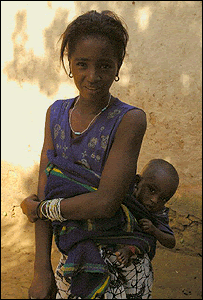
Ansata Bah jiggles the baby wrapped to her back. At 13 years old, she has the weight of her world on her shoulders.
Sangaredi, Guinea, West Africa
 "It is not hot news that most African countries possess resources-natural, human, and otherwise that if properly exploited would place African countries as one of the most richest in the world. But most of the continents resources are being exploited and taken to the western world at cheap rates, where they are processed and who becomes the sole consumer of the more expensive end products? The same people who produced the raw material in the first place. What is wrong with investing in Africa? This trend seems to have no end at hand.
Natives of this rural community in Guinea have every cause to become agog, their hearts filled with great anticipation for the future.
But the questions that pops up in mind is "How far will this go? When the need for increased production arises and computers begin to take over peoples jobs...will there still be anything left for these poor people who are devotedly making big sacrifices for their future and the future of their nation?"
We hope that this does not become another case of the Niger Delta in Nigeria; we hope that the plan in place is both efficient and effective, to ensure that these people are not only given fish but also taught how to fish-that they become trully empowered. We hope that this step taken by Global Alumina, will be followed by many more other foreign investors to help develop Africa.
Let us hope and pray that the future for the Sangaredi community, for Guinea, for Africa and indeed the third world will be as bright and beautiful as the smiles on the faces of these people."
Ansata Bah jiggles the baby wrapped to her back. At 13 years old, she has the weight of her world on her shoulders.
In March, she, along with her child, husband and fellow villagers, have to move out of their settlement in rural Guinea, West Africa.
They are making way for a new $3bn (£1.5bn) factory that in 2009 will start to turn Guinea's vast supplies of bauxite into alumina, the aluminium ore from which aluminium is made.
But what could have been a nightmarish corporate attack on village life may prove a blessing.
The project, based in Sangaredi, is giving hope to poor communities desperate for jobs that have for decades seen their region's mineral wealth exploited abroad.
"If I can get some activity, it doesn't matter what - washing clothes, preparing food - I won't hesitate to do it," says Ms Bah.
"Whether it's during the phase of construction or exploitation, anything that I can do to earn money I'll do.
"If I gain work here, living standards will improve compared with now."
Exploited abroad
Despite possessing at least a third of the world's bauxite reserves, Guinea has failed to convert it into a more precious commodity.
Foreign aluminium companies, such as US-based Alcoa and Canadian firm Alcan, mine the rock in Guinea, but transport it abroad for refining.
It means the country misses out on a crucial economic boost: whereas a tonne of bauxite costs about $20 on the world market, spot prices for refined alumina can reach $400 a tonne.
Global Alumina, the Canadian-listed company behind the new plan, hopes to produce 2.8m tonnes of alumina per year from the new plant when it opens in 2009.
Often critical of the motives and priorities of big business in Africa, development organisations are behind the project.
"Nothing of this scale has been done in Guinea before," says Lamine Bangura at Centre d'Appui au Developpement (CAD), a local non-governmental organisation supported by the US-backed African Development Foundation, which has entered into a $10m partnership with Global Alumina to oversee training, construction and sustainability issues related to the refinery in the area.
"It will create a great deal of employment.
"The installation of the factory will bring great development for this community."
Social developments
"Global is a detonator," says Noramou Cece, technical advisor at the Ministry of Mines.
"The company has consulted at the base, family by family, individual by individual, to reassure the population that Global Alumina will listen to them.
"As a result, there is a new spirit taken on by the mining companies that come here - that they must be involved in the development of community at the grassroots level."
A four-year social and environmental impact assessment, one of the most far-reaching of its kind, sought out the opinions of each of the 4,000 locals affected by the refinery.
Ansata Bah is one of the beneficiaries of a $10m compensation package that will see two new villages built, complete with new sanitation, schools and dispensaries, compensation for lost trees and parcel lands, alongside increasing roles for women and the much-hoped-for prospect of jobs.
Ms Bah personally received compensation for her own mango and lemon trees and the palm oil that she makes with the other women.
The women in her village know how much she has received, but she says the men, including her husband, are not allowed to know the amount.
Social change
Bringing an in-depth consultation process to traditional village communities has had far-reaching effects.
Many women have found a voice and independence for the first time.
"Women here are starting to have free thoughts as a result of our discussions," says Marliatou Diallo, women and vulnerable persons officer at Global Alumina.
"Before, women could not even express themselves in front of men, and definitely not take a decision.
"Now they can explain their problems to the men and give their opinions and concerns."
The United Nations Development Programme (UNDP) has partnered with Global Alumina to try to meet the Millennium Development Goals on halving extreme poverty by 2015.
Together Global Alumina and the UNDP will commit hundreds of thousands of dollars for projects including vocational training, developing small businesses and financing micro enterprises.
Global Alumina will also fund mid-wife training and poverty-alleviation programmes.
Job hopes
As Guinea's largest foreign direct investment yet, the whole country is waiting for jobs at the factory with bated breath.
Guinea suffers from chronic unemployment, particularly among young people, and even those with secondary and tertiary qualifications struggle to find jobs.
The economy is in freefall, with spiralling inflation, and the dire economic prospects sparked strikes and protests in 2006.
"We're going to take 3-4,000 workers from this area alone during construction, so that will have a big impact for the inhabitants of this region," says Mamady Youla, Director General of Guinea Alumina Corporation, Global Alumina's subsidiary in Guinea.
"Once the factory starts we will employ around 2,000 people directly, but you must also take into account the indirect employment generated by the project - we expect about 10,000 jobs to be generated in the region."
The Guinean government has realised the importance of the project, and created incentives, including a fifteen-year tax holiday, with no taxes on profits for the first five years, to sweeten the deal.
As a result, other companies, including Alcoa/Alcan, Mitsubishi, Chalco and Brazilian firm CVRD, are looking at the possibility of establishing alumina refineries in the country.
In the long-term, Youla estimates that revenues in the order of $100m could accrue to government every year.
He is pushing for a greater percentage of these taxes to go to the local community. Currently only 0.4% of revenues has to go to the local area, but he would like to see this increased to 5% or 10%.
Better living standards
Souleymane Bah, 70, a village elder from Petoun Djiga, one of the two villages that will be relocated, cannot wait for the project to gather pace.
He received a cheque compensating him and his family for 50 trees.
"We are only farmers, so it's thanks to Global that I ever touched a cheque. We are very content for them to be here," he says.
"I want the project to develop as quickly as possible, he says.
"We ourselves think of development, and that's why we accepted to be relocated.
"If young people can find employment around the project here, then we think living standards will improve."
Oil Gunmen kill Nigerian Chiefs

BBC NEWS
Gunmen in Nigeria's oil region have attacked and killed 12 people including four local chiefs, police say.
When The Foreign Expatriates are gone they turn to the "Local Expatriates", like crocodiles who eat their own eggs. "The popular quote in economics is thus justified: when the desireable is unavailable, the available becomes the desireable".
Two passengers who suffered gunshot wounds during the attack escaped from a boat that was carrying 14 passengers to Kula village in the Niger Delta.
The four chiefs were from the Kula kingdom in Rivers State.
Western oil companies have also evacuated their staff from three oil fields in the area, where kidnappings by armed groups are quite common.
Sources in the Kula community say the attack was prompted by disagreements between local groups over sharing out money distributed by oil companies operating there.
There are also reports that the attack could have been a result of a long-standing chieftaincy tussle.
The chiefs who were killed on Sunday had been in control in Kula over the past two years.
The faction that launched the boat attack are said to have been driven out of Kula two years ago after they challenged the authority of local chiefs to share oil money.
Although all of Nigeria's oil exports come from the Niger Delta, the region remains poor with local groups taking up arms to demand larger control of the oil wealth.
The government says instability in the Delta cost some $4.4bn last year.
Tuesday, January 9, 2007
U.S. Launches New Attacks in Somalia

By MOHAMED OLAD HASSAN, Associated Press Writer
U.S. helicopter gunships launched new attacks Tuesday against suspected al-Qaida members, a Somali official said, a day after American forces launched airstrikes in the first offensive in the African country since 18 U.S. troops were killed there in 1993.
The latest attacks killed at least 27 civilians in the town of Afmadow in southern Somalia, lawmaker Abdiqadir Daqane told The Associated Press.
At least one AC-130 gunship carried out an airstrike Monday evening against targets in the town about 220 miles southwest of the capital of Mogadishu, Somali officials said. It was not immediately clear how many people died in those attacks, but Somali officials said there were reports that many were killed.
The U.S. attacks were targeting Islamic extremists, said a Somali Defense Ministry official who spoke on condition of anonymity because he was not authorized to speak. Earlier, Somalia's president had said the U.S. was hunting suspects in the 1998 bombings of the two U.S. embassies in East Africa, and had his support.
The aircraft carrier USS Dwight D. Eisenhower arrived off Somalia's coast and launched intelligence-gathering missions over Somalia, the military said. Three other U.S. warships are conducting anti-terror operations off the Somali coast.
U.S. warships have been seeking to capture al-Qaida members thought to be fleeing Somalia after Ethiopia invaded Dec. 24 in support of the government and drove the Islamic militia out of the capital and toward the Kenyan border.
The Islamic extremists are believed to be sheltering suspects in the embassy bombings, and the raids are designed to keep the militants from posing a new threat to the government.
The White House would not confirm the attacks, nor would the Pentagon.
A U.S. government official said at least one AC-130 gunship was used Monday evening. The official spoke on condition of anonymity because of the operation's sensitivity.
It was the first U.S. offensive in the Horn of Africa country since the Americans led a U.N. force in the 1990s that intervened in Somalia in an effort to fight famine. The mission led to clashes between U.N. forces and Somali warlords, including the "Black Hawk Down" battle that left 18 U.S. servicemen dead.
Witnesses said at least four civilians were killed Monday 30 miles east of Afmadow, including a small boy. The claims could not be independently verified.
"My 4-year-old boy was killed in the strike," Mohamed Mahmud Burale told the AP by telephone. "We also heard 14 massive explosions."
Government spokesman Abdirahman Dinari said it was not known how many people were killed, "but we understand there were a lot of casualties. Most were Islamic fighters."
Witnesses said that in Tuesday's attack, the helicopters opened fire on the road that leads to the Kenyan border. They said they could not clearly make out the markings on the aircraft.
Daqane said two newlyweds were among the dead Tuesday.
The U.S. Embassy in Nairobi reissued a terror warning Tuesday to Americans living in or visiting the Horn of Africa.
Monday evening's airstrike came after the suspects were seen hiding on a remote island on the southern tip of Somalia, close to the Kenyan border, Somali officials said. The island and a site near the village of Hayi, 155 miles to the north, were hit.
The main target was Fazul Abdullah Mohammed, who allegedly planned the 1998 attacks on the U.S. embassies in Nairobi and Dar es Salaam, Tanzania, that killed 225 people.
He is also suspected of planning the car bombing of a beach resort in Kenya and the near simultaneous attempt to shoot down an Israeli airliner in 2002. Ten Kenyans and three Israelis were killed in the blast at the hotel, 12 miles north of Mombasa. The missiles missed the airliner.
Fazul, 32, joined al-Qaida in Afghanistan and trained there with Osama bin Laden, according to the transcript of an FBI interrogation of a known associate. He came to Kenya in the mid-1990s, married a local woman, became a citizen and started teaching at a religious school near Lamu, just 60 miles south of Ras Kamboni, Somalia, where one of the airstrikes took place Monday.
Largely isolated, the coast north of Lamu is predominantly Muslim and many residents are of Arab descent. Boats from Lamu often visit Somalia and the Persian Gulf, making the Kenya-Somalia border area ideal for him to escape.
President Abdullahi Yusuf told journalists in the capital, Mogadishu, that the U.S. "has a right to bombard terrorist suspects who attacked its embassies." Deputy Prime Minister Hussein Aideed told The Associated Press the U.S. had "our full support for the attacks."
But others in the capital said the attacks would only increase anti-American sentiment in the largely Muslim country.
"U.S. involvement in the fighting in our country is completely wrong," said Sahro Ahmed, a 37-year-old mother of five.
Already, many people in predominantly Muslim Somalia had resented the presence of troops from neighboring Ethiopia, which has a large Christian population and has fought two brutal wars with Somalia, most recently in 1977.
The U.S. Central Command reassigned the Eisenhower to Somalia last week from its mission supporting NATO-led forces in Afghanistan, said U.S. Navy spokesman Lt. Cmdr. Charlie Brown in Bahrain, where the Navy's Fifth Fleet is based.
"Eisenhower aircraft have flown intelligence-gathering missions over Somalia," Brown told The Associated Press.
The spokesman said the Eisenhower was the only U.S. aircraft carrier in the region. The vessel is carrying approximately 60 aircraft, including four fighter jet squadrons, he said.
Ethiopia forces had invaded Somalia to prevent an Islamic movement from ousting the weak, internationally recognized government from its lone stronghold in the west of the country. The U.S. and Ethiopia both accuse the Islamic group of harboring extremists, among them al-Qaida suspects.
Ethiopian troops, tanks and warplanes took just 10 days to drive the Islamic group from the capital, Mogadishu, and other key towns.
Ethiopian and Somali troops had in recent days cornered the main Islamic force in Ras Kamboni, a town on Badmadow island, with U.S. warships patrolling offshore and the Kenyan military guarding the border to watch for fleeing militants.
The AC-130 is armed with 40 mm guns that fire 120 rounds per minute and a 105 mm cannon, normally a field artillery weapon. The gunships were designed primarily for battlefield use to place saturated fire on massed troops.
U.S. officials said after the Sept. 11 attacks that extremists with ties to al-Qaida operated a training camp at Ras Kamboni and al-Qaida members are believed to have visited it.
Leaders of the Islamic movement have vowed from their hideouts to launch an Iraq-style guerrilla war in Somalia, and al-Qaida chief Osama bin Laden's deputy has called on militants to carry out suicide attacks on the Ethiopian troops.
Ethiopian Prime Minister Meles Zenawi said in an interview published Tuesday in the French newspaper Le Monde that suspected terrorists from Canada, Britain, Pakistan and elsewhere have been among those taken prisoner or killed in the military operations in Somalia.
Somalia has not had an effective central government since clan-based warlords toppled dictator Mohamed Siad Barre in 1991 and then turned on each other, sinking the Horn of Africa nation of 7 million people into chaos.
A U.N. peacekeeping force, including U.S. troops, arrived in 1992, but the experiment in nation-building ended the next year when fighters loyal to clan leader Mohamed Farah Aideed shot down a U.S. Army Black Hawk helicopter and battled American troops, killing 18 servicemen.
At least 13 attempts at government have failed since then. The current government was established in 2004 with U.N. backing.
Subscribe to:
Posts (Atom)
